Akshat Mishra — Back to top

Software engineer · B.Tech Computer Science, class of 2027

Akshat Mishra

I build software where the database, the tests and the numbers have to agree.

Five projects designed, tested and deployed in 2026, in Java and Spring Boot, Python and FastAPI, PostgreSQL and React. I am looking for a graduate software engineering role in Japan from 2027, and I am open to backend, full-stack and data roles elsewhere.

projects deployed in 2026
5
automated tests across the five
6,052
software internships
2
English (EF SET) · Japanese (JLPT N3 level, self-assessed)
C2 · N3
01

About

I like the unglamorous parts of software: constraints, migrations, retries, tests, and what happens when two requests arrive at the same moment.

I am a computer science undergraduate at Bennett University, graduating in 2027. In 2026 I built and deployed five projects, each organised around one hard question. Can a database refuse an illegal shift by itself? Can a language model’s claims be checked line by line? Can 341 grammar rules run in milliseconds with no neural network?

Most of my work is backend: Java with Spring Boot, Python with FastAPI, and PostgreSQL underneath, with React and TypeScript in front and Docker, GitHub Actions and Azure around it. Two of the five are data projects, built on ETL pipelines, SQL marts and statistics that state their own limits.

Two internships gave me the team side: a five-person team building a Spring Boot and MySQL research portal, and React pages for a company website.

I am learning Japanese (around JLPT N3 level, self-assessed). Three of the projects have a Japanese interface, and one is about the language itself.

Based in
New Delhi, India (UTC+5:30)
Degree
B.Tech, Computer Science and Engineering · Bennett University · 2023 – Present
Looking for
A graduate software engineering role in Japan from 2027. Also backend, full-stack and data roles globally, and internships before then.
Languages
English: C2 (EF SET 71/100). Japanese: around JLPT N3 level, self-assessed, no certificate yet.
02

Projects

Five finished projects, built in October and November 2026. Each one is deployed, has an automated test suite, and states what it does not do. They are personal projects: none has real users, traffic or revenue.

  1. 01 Yoyū Work-hour tracking for international students in Japan. Full-stack · Backend
  2. 02 Kensa A local-first investigator for failed GitHub Actions runs. AI engineering · Developer tools
  3. 03 Kaidoku A Japanese reading companion that shows the grammar inside any text. Backend · Algorithms · PWA
  4. 04 MIERU Retail analytics that shows where every number came from. Data analytics · Data science
  5. 05 Hoshizora A bilingual space-data platform where every number has a source. Data engineering · Analytics
  6. 06 KIZASHI Forecasting Japanese electricity demand. It is still being built, so there are no results, screenshots or links to show yet. In development

01/ 05Oct – Nov 2026

Yoyū

yoyū · “leeway, room to breathe”

Work-hour tracking for international students in Japan.

Full-stack · Backend

Free tier: the first load takes about 40 seconds.

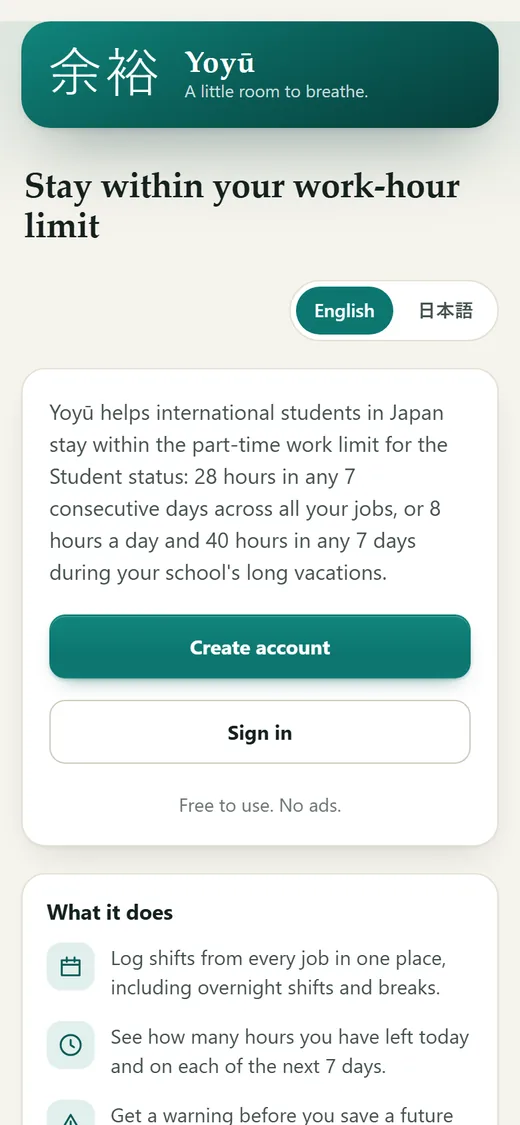
Yoyū landing page: “Stay within your work-hour limit”, with English and Japanese switch, account buttons and a feature list. (opens in a new tab)
Yoyū landing page on a phone-sized screen.
Screenshot of the live app, captured 15 Nov 2026.

The problem

International students in Japan may work at most 28 hours in any 7 consecutive days, summed across every part-time job. Each employer only sees its own hours, so the student is the only one who can keep the total.

What I built

A bilingual (English/Japanese) installable PWA. A framework-free Java compliance engine evaluates every rolling 7-day window, overnight shifts and vacation-period limits behind a Spring Boot REST API, and PostgreSQL itself rejects overlapping shifts.

Engineering highlights

  • Integrity lives in the database: a GiST exclusion constraint makes overlapping shifts impossible, while per-user row locks, optimistic locking and idempotency keys keep concurrent and retried writes consistent.
  • Google and LINE sign-in through Spring Security (OAuth 2.0 / OpenID Connect with PKCE), plus HMAC-hashed email codes, CSRF protection and rate limiting.
  • Schedule import that stays on the device: PDF.js and Tesseract.js OCR run in the browser, and an imported batch is saved atomically (all rows or none).
  • Hosted on free tiers (Azure App Service and Neon PostgreSQL), so the first load after an idle period takes about 40 seconds.
REST endpoints
42
Flyway migrations
10
backend tests (JUnit 5, Testcontainers)
511
frontend tests (Vitest)
537

Stack

  • Java 21
  • Spring Boot 4
  • Spring Security
  • PostgreSQL 16
  • Flyway
  • React 19
  • TypeScript
  • PWA
  • Docker
  • Azure App Service

How a request moves through it
  1. React PWA
  2. Spring Security: session, CSRF, OIDC
  3. REST controllers and validation
  4. Services: user lock, idempotency
  5. Pure Java compliance engine
  6. PostgreSQL: GiST exclusion constraint
Limits, stated plainly
  • A personal project with no real users.
  • Deploys are manual, and there is no automated end-to-end browser suite.
  • The current source is in a private repository, so only the live app is linked.
02/ 05Oct – Nov 2026

Kensa

kensa · “inspection”

A local-first investigator for failed GitHub Actions runs.

AI engineering · Developer tools

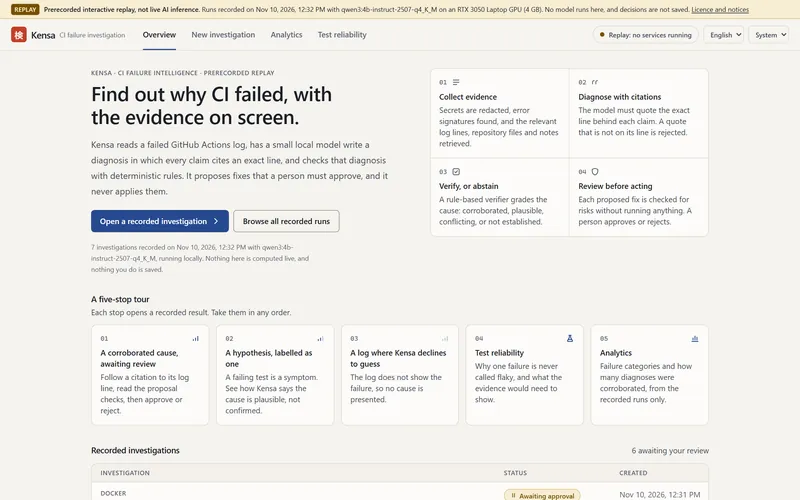
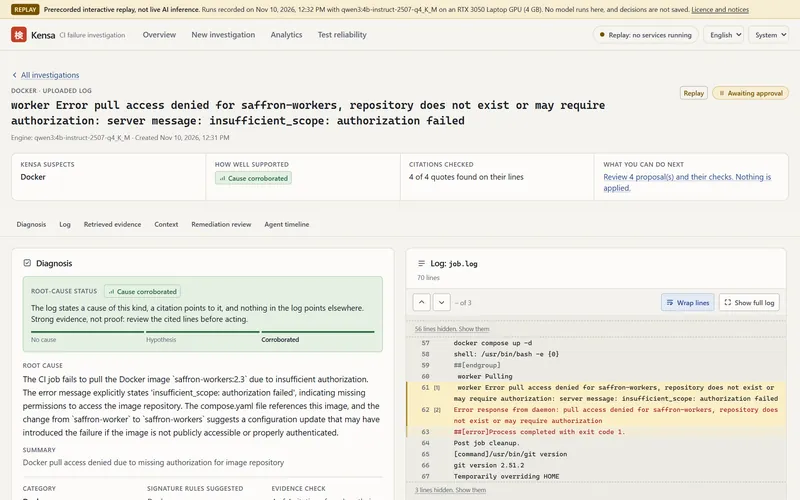
Kensa report in the public replay: a diagnosis marked “cause corroborated” beside the cited log lines. (opens in a new tab)
Kensa overview page with a banner stating it is a prerecorded interactive replay, not live AI inference.
Screenshot of the live app, captured 15 Nov 2026.

Note The public link is a static, interactive replay of seven prerecorded investigations. No model and no backend run on that page.

The problem

When CI fails, the cause is somewhere in thousands of log lines. A language model can summarise them fluently and still be wrong, and nothing in the summary tells you which.

What I built

A FastAPI backend collects evidence from the log, the workflow and the failing commit, and retrieves context with hybrid full-text and vector search on PostgreSQL with pgvector. A local, quantized Qwen3 4B model served by Ollama drafts a diagnosis that must cite log lines, and every citation is then verified deterministically against the stored evidence.

Engineering highlights

  • Checkable output: all 646 accepted citations were genuine on a held-out synthetic set. Proposed fixes need human approval and are never applied automatically.
  • Crash-resumable LangGraph workflows on a PostgreSQL job queue: FOR UPDATE SKIP LOCKED, leases, fencing tokens and retries with backoff.
  • 31 tables and 15 reversible Alembic migrations, with incremental CI-history ETL, flaky-test analysis and OpenTelemetry tracing.
  • Inference runs on a laptop GPU through Ollama. No paid API is involved.
accepted citations genuine (held-out synthetic set)
646 / 646
backend tests (pytest)
666
frontend tests (Vitest)
83
end-to-end tests (Playwright)
30

Stack

  • Python 3.13
  • FastAPI
  • PostgreSQL 18
  • pgvector
  • LangGraph
  • Ollama
  • React
  • TypeScript
  • Playwright
  • OpenTelemetry

How a request moves through it
  1. Failed run: log, workflow, commit
  2. Ingest: redact secrets, chunk
  3. Job queue: SKIP LOCKED, leases
  4. Retrieve: full-text and vector
  5. Diagnose: local model, must cite
  6. Verify citations deterministically
  7. Human approves or rejects
Limits, stated plainly
  • Accuracy figures come from synthetic evaluation sets, not real-world CI failures.
  • In my measurements hybrid retrieval did not beat plain full-text search, and the project reports that result.
  • It is a single-operator local tool: there is no login and no hosted AI service.

03/ 05Oct – Nov 2026

Kaidoku

kaidoku · “deciphering”

A Japanese reading companion that shows the grammar inside any text.

Backend · Algorithms · PWA

Scales to zero when idle: the first load can take about 20 seconds.

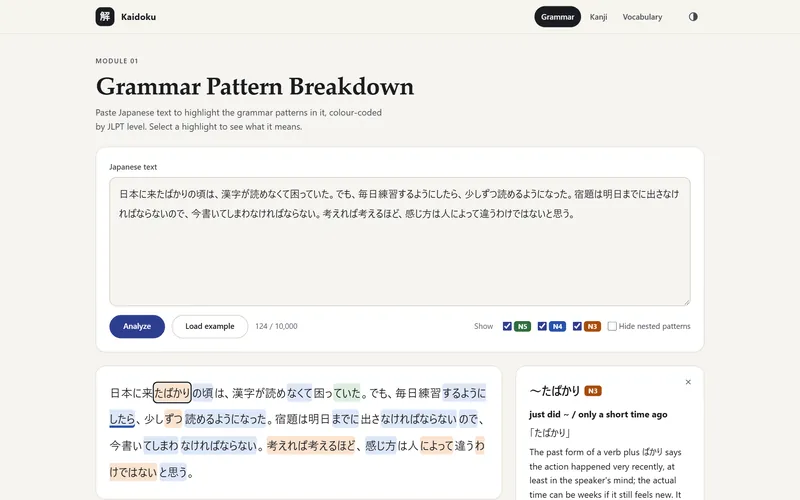
Kaidoku grammar analyser: a Japanese paragraph with grammar patterns highlighted by JLPT level and an explanation panel. (opens in a new tab)
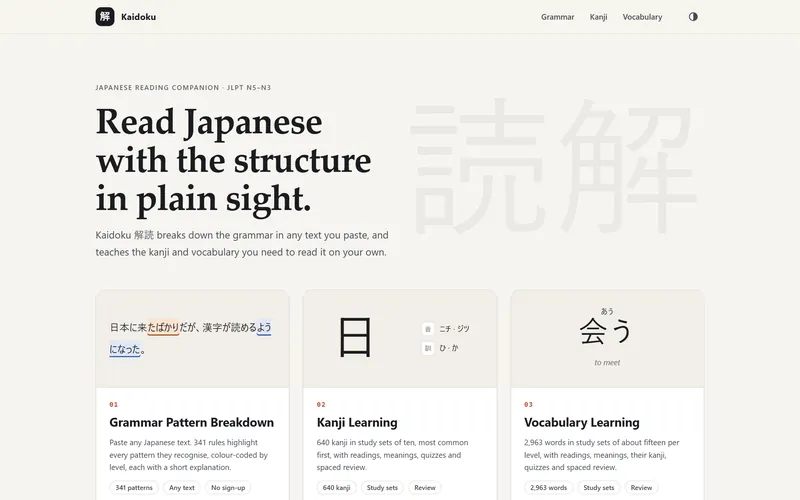
Kaidoku home page: “Read Japanese with the structure in plain sight”, with grammar, kanji and vocabulary modules.
Screenshot of the live app, captured 15 Nov 2026.

The problem

A dictionary explains words, but grammar hides inside conjugated text. Kaidoku highlights the patterns where they occur and teaches the kanji and vocabulary around them.

What I built

A deterministic rule engine (rule-based, no machine learning) over Kuromoji morphological tokens: 341 JLPT N5–N3 grammar rules written as data and matched by a BitSet-based, NFA-style simulation without backtracking. Around it, an installable offline PWA teaches 640 kanji and 2,963 words through 2,926 validated reading questions with SM-2-style spaced repetition.

Engineering highlights

  • Measured, not assumed: 99.2% precision and 98.9% recall on a 655-sentence regression set covering the original 199 rules, with a floor enforced in CI.
  • About 13 ms to match 10,000 characters in a local benchmark.
  • Learner progress stays in the browser: transactional IndexedDB with backup and restore, and versioned service-worker caches.
  • GitHub Actions builds the Docker image that runs on Azure Container Apps.
JLPT N5–N3 grammar rules
341
precision on the 655-sentence regression set
99.2%
unit and integration tests
3,374
browser tests (Playwright)
78

Stack

  • Java 21
  • Spring Boot
  • Kuromoji
  • JavaScript
  • IndexedDB
  • Service Worker
  • Docker
  • GitHub Actions
  • Azure Container Apps
  • Playwright

How a request moves through it
  1. Japanese text, up to 10,000 characters
  2. Kuromoji morphological tokens
  3. Candidate index narrows the rules
  4. BitSet NFA matcher, 341 rules
  5. Matches by JLPT level
  6. Highlighted text and explanations
Limits, stated plainly
  • Evaluation sentences are model-generated and have not been reviewed by a native speaker.
  • The interface is English only.
  • Covers JLPT N5 to N3. It is rule-based: no machine learning is involved.

04/ 05Oct – Nov 2026

MIERU

mieru · “to be visible”

Retail analytics that shows where every number came from.

Data analytics · Data science

Scales to zero when idle: the first load takes a few seconds.

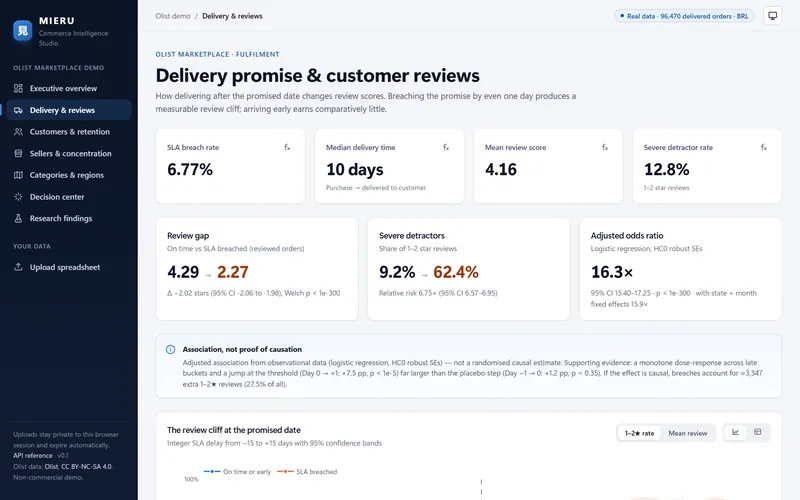
MIERU delivery and reviews dashboard: SLA breach rate, review gap, an adjusted odds ratio of 16.3 and a note that this is association, not proof of causation. (opens in a new tab)
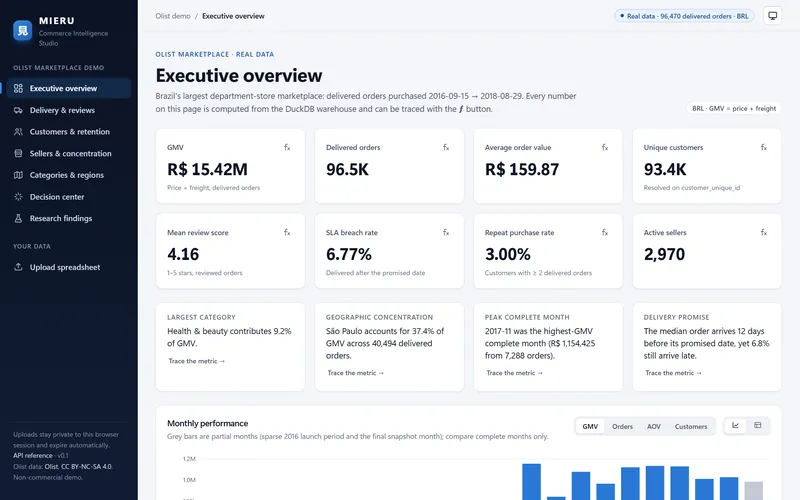
MIERU executive overview: GMV, delivered orders, average order value and monthly performance for the Olist demo.
Screenshot of the live app, captured 15 Nov 2026.

The problem

Sales exports arrive as messy spreadsheets: mixed encodings, ambiguous columns, totals counted twice. A dashboard built on them is only as trustworthy as cleaning that nobody can see.

What I built

A FastAPI, DuckDB and pandas application. Uploaded CSV and Excel files are profiled (encoding, including Shift_JIS, delimiter and column roles), mapped to a canonical schema and cleaned by reversible, audited data-quality policies. Metrics are parameterized DuckDB SQL: a revenue bridge, rule-based RFM segmentation, right-censored cohorts and Pareto/Gini concentration.

Engineering highlights

  • Validated on the public Olist marketplace dataset: a generic upload of 112,650 order lines reproduces direct SQL exactly, and seven DuckDB marts power dashboards over 96,470 delivered orders.
  • Statistics with stated limits: chi-square, Welch t-test, Mann–Whitney and logistic regression. A missed delivery date is associated with 16.3 times higher odds of a 1–2 star review (95% CI 15.4–17.3, observational).
  • Forecasts judged against baselines: Ridge and Random Forest were compared with naive baselines by rolling-origin backtest. The simple baselines won, and the app reports that.
delivered Olist orders behind the dashboards
96,470
uploaded order lines matching direct SQL exactly
112,650
odds of a 1–2 star review after a missed delivery date (observational)
16.3×
tests: 119 backend, 113 frontend
232

Stack

  • Python 3.14
  • FastAPI
  • DuckDB
  • pandas
  • NumPy
  • SciPy
  • statsmodels
  • scikit-learn
  • React 19
  • TypeScript
  • Plotly
  • Docker
  • Azure Container Apps

How a request moves through it
  1. CSV or Excel export
  2. Profile: encoding, delimiter, column roles
  3. Canonical schema
  4. Quality policies: reversible, audited
  5. DuckDB marts and metric SQL
  6. Statistical tests and backtests
  7. Dashboards and exports
Limits, stated plainly
  • Olist is a public Brazilian marketplace dataset, not client data.
  • The findings are observational and do not show causation.
  • RFM segmentation is rule-based, and the Japanese interface is not built yet.

05/ 05Oct 2026

Hoshizora

hoshizora · “starry sky”

A bilingual space-data platform where every number has a source.

Data engineering · Analytics

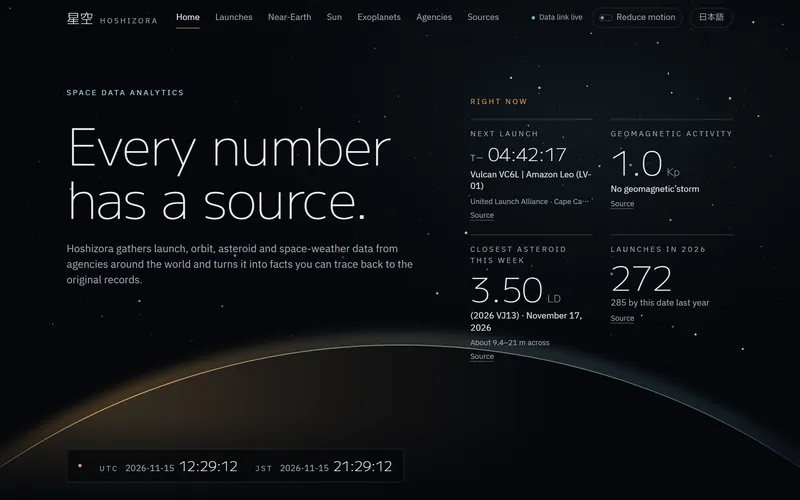
Hoshizora home page: “Every number has a source”, with the next launch countdown and current space-weather figures. (opens in a new tab)
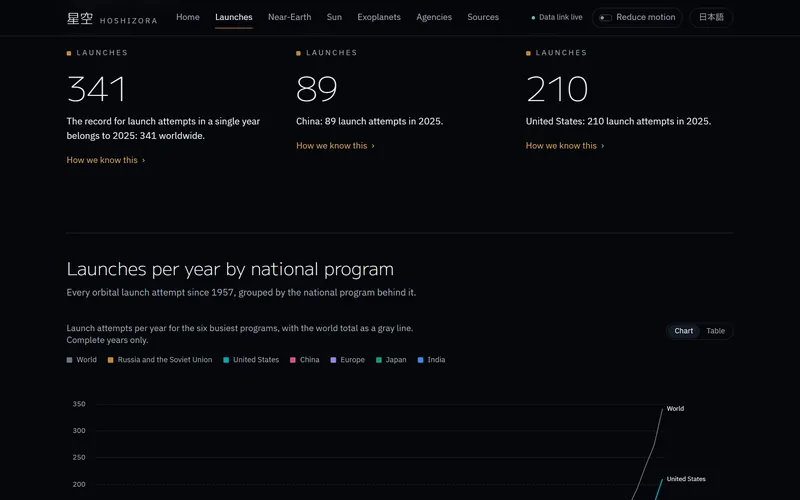
Hoshizora launches page: launch facts and a line chart of launches per year by national program.
Screenshot of the live app, captured 15 Nov 2026.

The problem

Launch, satellite, asteroid, space-weather and exoplanet data live in five public APIs with different formats, quotas and update schedules, and a chart is only useful if you can trace it back to them.

What I built

A Python 3.14 ETL pipeline lands raw payloads, normalises them and refreshes SQL marts in PostgreSQL 18 across raw, core, mart and fact layers (21 Flyway migrations, 15 materialized-view marts). A read-only Java 25 and Spring Boot 4 API with 29 GET routes serves a React and ECharts front end in English and Japanese.

Engineering highlights

  • Quota-safe, resumable ingestion: per-source rate limits, exponential backoff, watermark-based incremental loads, SHA-256-deduplicated raw storage and idempotent upserts.
  • Lineage by construction: 392,534 links trace rows back to their source records.
  • Analytics written in SQL: window functions, filtered aggregates and materialized views for launch cadence by nation, rolling 20-launch success rates, booster reuse and exoplanet size distributions.
launches
8,147
catalogued space objects
71,090
asteroid close approaches
52,153
automated tests
541

Stack

  • Python 3.14
  • SQL
  • PostgreSQL 18
  • Flyway
  • Java 25
  • Spring Boot 4
  • React 19
  • TypeScript
  • ECharts
  • Docker
  • Azure

How a request moves through it
  1. Five public APIs
  2. Python ETL: rate limits, backoff
  3. raw: hashed payloads
  4. core: normalised, with lineage
  5. mart: materialized views
  6. Read-only Spring Boot API
  7. React and ECharts, EN / JA
Limits, stated plainly
  • Scheduled ingestion is partly on hold: one source has been paused since 22 October 2026, so some data is several weeks old.
  • It is not a real-time feed.
  • No pandas and no machine learning: the analytics are SQL.
03

Expertise

Grouped by discipline. Everything listed was used in one of the five projects or in an internship: pick a project to see its stack.

Languages

  • Java
  • Python
  • TypeScript
  • JavaScript
  • SQL

Backend and APIs

  • Spring Boot
  • Spring Security
  • Spring MVC
  • JPA / Hibernate
  • FastAPI
  • SQLAlchemy
  • REST APIs
  • OAuth 2.0 / OIDC

Databases

  • PostgreSQL
  • MySQL
  • DuckDB
  • pgvector
  • Flyway
  • Alembic
  • Transactions and concurrency control
  • Window functions, materialized views
  • Data modeling

Data engineering and analytics

  • ETL pipelines
  • Incremental, idempotent loads
  • Data-quality checks
  • Data lineage
  • pandas
  • NumPy
  • SciPy
  • statsmodels
  • scikit-learn
  • Hypothesis testing
  • Logistic regression
  • RFM and cohort analysis
  • Forecast backtesting
  • ECharts
  • Plotly

Frontend

  • React
  • Vite
  • HTML
  • CSS
  • Progressive Web Apps
  • Service workers
  • IndexedDB
  • Figma

AI engineering

  • LangGraph
  • Ollama (local LLMs)
  • Retrieval-augmented generation
  • Kuromoji (Japanese NLP, rule-based)

Testing and observability

  • JUnit 5
  • MockMvc
  • Testcontainers
  • pytest
  • Vitest
  • Playwright
  • OpenTelemetry

DevOps and cloud

  • Docker
  • Docker Compose
  • GitHub Actions (CI)
  • Azure App Service
  • Azure Container Apps
  • Git
  • Linux
04

Engineering approach

Six habits I try to keep, each with the place in the projects where you can check it.

  1. Put the rule where it cannot be skipped.

    • Yoyū

      Yoyū Overlapping shifts are rejected by a PostgreSQL GiST exclusion constraint, not only by application code.

    • Kaidoku

      Kaidoku Grammar rules are data with a precision floor enforced in CI, so a rule change that lowers accuracy fails the build.

    • Hoshizora

      Hoshizora Blocking data-quality checks stop a load when a source sends codes that are not mapped.

  2. Assume two requests arrive at once.

    • Yoyū

      Yoyū Per-user row locks, optimistic locking and idempotency keys keep concurrent and retried writes consistent.

    • Kensa

      Kensa The job queue claims work with FOR UPDATE SKIP LOCKED and guards it with leases and fencing tokens.

    • Hoshizora

      Hoshizora Idempotent upserts mean a repeated ingestion run changes nothing.

  3. Make every claim checkable.

    • Kensa

      Kensa The model must cite log lines, and each citation is verified deterministically against stored evidence.

    • MIERU

      MIERU A generic upload of 112,650 order lines is tested to reproduce direct SQL exactly.

    • Hoshizora

      Hoshizora 392,534 lineage links connect rows to the source records they came from.

  4. Test at the boundary that breaks.

    • Yoyū

      Yoyū 511 backend tests run against a real PostgreSQL through Testcontainers, alongside 537 frontend tests.

    • Kaidoku

      Kaidoku 3,374 unit and integration tests and 78 Playwright browser tests.

    • Kensa

      Kensa 666 backend, 83 frontend and 30 end-to-end tests pass in CI.

  5. Treat security as part of the feature.

    • Yoyū

      Yoyū OAuth 2.0 / OpenID Connect with PKCE, HMAC-hashed email codes, CSRF protection and rate limiting.

    • Kensa

      Kensa Proposed fixes need human approval and are never applied automatically.

    • MIERU

      MIERU Uploads stay private to the browser session, are size-bounded and expire automatically, and exports are safe against spreadsheet formula injection.

  6. Report the result you actually got.

    • MIERU

      MIERU Ridge and Random Forest forecasts lost to simple baselines in rolling-origin backtests, and the app says so.

    • Kensa

      Kensa Hybrid retrieval did not beat plain full-text search in my measurements, so I do not claim that it does.

    • Kaidoku

      Kaidoku Accuracy is reported with its caveat: the evaluation sentences are model-generated, without native-speaker review.

05

Experience and education

Internships

  1. Jan 2026 – Feb 2026

    Software Development Intern

    Ornate TechnoServices Pvt. Ltd. · Greater Noida, India · on-site

    • Implemented backend, frontend and data-management tasks in Java/Spring Boot, React and MySQL for an in-development government-related research portal that stores and searches scientists’ profiles and research records.
    • Worked in a five-person team using Git/GitHub and daily stand-ups; changes were merged into the team codebase.
  2. Jun 2025 – Jul 2025

    Web Development Intern

    Medelan Life Sciences Pvt. Ltd. · Ghaziabad, India · hybrid

    • Built pages for the company website in React, JavaScript, HTML and CSS with one other developer, some independently.
    • Designed page layouts in Figma and refined them through regular review feedback; managed changes with Git/GitHub.

Education

  1. 2023 – Present

    B.Tech in Computer Science and Engineering

    Bennett University · Greater Noida, India

    • Coursework: Data Structures, Algorithms, Object-Oriented Programming, DBMS, Operating Systems, Computer Networks.
  2. CBSE Board

    St Thomas School · Ghaziabad, Uttar Pradesh, India

Spoken languages

  • EnglishC2EF SET 71/100
  • JapaneseN3 levelJLPT N3 level, self-assessed. No certificate yet.

Competitive programming

07

Résumé

Two versions, one page each, both dated November 2026. (The PDFs are in English.)

Software engineering

Backend and full-stack

Java, Spring Boot, FastAPI, PostgreSQL and React. Features Yoyū, Kensa and Kaidoku.

PDF · 1 page · 178 KB

Data

Analytics, engineering and science

Python, SQL, PostgreSQL, DuckDB and statistics. Features Hoshizora and MIERU.

PDF · 1 page · 154 KB

08

Contact

Hiring for 2027? I would like to hear from you.

I am looking for a graduate software engineering role in Japan from 2027, and I am open to backend, full-stack and data roles elsewhere, including internships before then. Email is the most reliable way to reach me.

akshatm.work23@gmail.com

Local time: New Delhi Tokyo